
 Procedures

Online mailbox
Receiving feedback and proposals from organizations and individuals.

The waste incineration plant project has an expected capacity to process 2,000 tons of household waste/day. Accordingly, the construction of the waste power plant is divided into 2 phases: Phase 1 (from 2021 to 2025) builds a waste power plant with a capacity to process 1,000 tons of household waste/day, generating about 20 MW of electricity; Phase 2 will be implemented after 2026.
Total investment for phase 1 is about 110 million USD. Hai Phong City proposes to invest in building a waste power plant according to the public-private partnership (PPP) method. In particular, technology, investment capital, and management experience will be mobilized from the private economic sector.
Trash incineration power plants have the advantage of saving land used for domestic solid waste treatment, with an operating time of 30-50 years. If advanced waste incineration technology is used to generate electricity, there is also the advantage of not having to classify waste sources from the source.
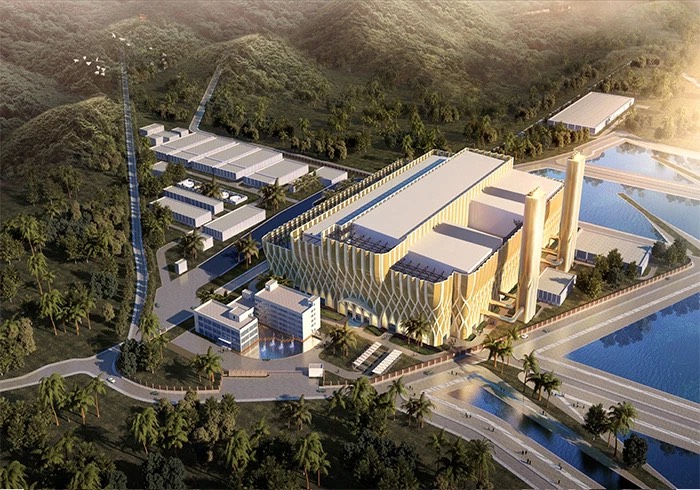
According to Hai Phong City's assessment, calling for investment in Hai Phong's waste power plant is also consistent with the National Electricity Development Planning Project for the period 2021-2030, with a vision to 2045, which has just been submitted to the Government for approval by the Ministry of Industry and Trade.
Every day, Hai Phong has to process nearly 2,000 tons of waste, of which, urban waste is more than 1,100 tons; Waste in rural areas is more than 600 tons. The remaining is industrial solid waste; agriculture; build; hazardous medical waste. Over time, the volume of waste increases and treatment facilities cannot keep up.
Currently, Hai Phong only has waste treatment areas in Dinh Vu, Trang Cat and Gia Minh (Thuy Nguyen district) with a total area of more than 110 hectares, mainly landfilling but always in a state of overload.
In particular, Trang Cat solid waste treatment area (44ha) is expected to close to reception in 2025; Dinh Vu solid waste treatment area is larger than 29.6 hectares, there are still more than 14 hectares that have not been cleared but must still be closed to reception in 2023 because it is located in the Dinh Vu-Cat Hai economic zone. Gia Minh solid waste treatment area is more than 36.5 hectares wide, expected to be put into operation from December 2021, with the capacity to receive and process about 630 tons of household waste/day.
The remaining suburban districts of Hai Phong are still processing household waste at temporary landfills. Therefore, Hai Phong also researched and proposed to invest in a second waste incineration plant, electricity generation plant and fertilizer production line to treat waste in rural areas. According to the proposal, the second waste power plant will be studied and located in Tran Duong commune, Vinh Bao district.
Hai Phong's report clearly states that with increasing pressure on household waste treatment, choosing technology to treat household waste using advanced waste incineration to generate electricity is appropriate.
If invested, the waste power plant will process old household waste at Dinh Vu landfill and the amount of household waste generated by Hai Phong and neighboring provinces. This waste treatment plant will thoroughly handle problems that arise during the process of burning waste to generate electricity, ensuring safety and environmental sanitation. This will be a breakthrough solution, not only solving the long-standing problem of trash but also turning trash into new energy. More importantly, this is an important step forward in building a civilized and modern city of Hai Phong, something that the city's people always look forward to.
Vinh Quan, Hai Yen
Source: thanhpthanhphohaiphong.gov.vn