
 Procedures

Online mailbox
Receiving feedback and proposals from organizations and individuals.

Investment processes and procedures for foreign investors according to the Investment Law 2014 On December 24, 2014, the Department of Legal Affairs, Ministry of Planning and Investment organized [...]
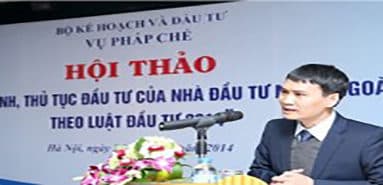
 On December 24, 2014, the Department of Legal Affairs, Ministry of Planning and Investment organized a workshop on "Investment processes and procedures of foreign investors taccording to the provisions of the Investment Law 2014". Attending the conference were Mr. Quach Ngoc Tuan, Deputy Director of the Legal Department; Mr. Vu Van Chung, Deputy Director of the Foreign Investment Department; and representatives of law firms and consulting companies.
Investment Law No. 67/2014/QH13 passed by the 13th National Assembly on November 26, 2014 includes 7 chapters, 76 articles, with 6 most important reform points. Ensuring the implementation of the Constitutional principle of citizens' freedom to invest and do business in industries and occupations that the Law does not prohibit. In particular, the collection, review and specific regulation of the two above-mentioned Lists in this Law by the exclusion method (select out) has contributed to a fundamental innovation in the principle of applying the law, from investors only having the right to conduct investment and business activities in the industries that the law allows to the principle of freedom to invest and do business in all industries. which the Law does not prohibit or require with conditions. Consolidate and complete the investment assurance mechanism in accordance with Hieu's regulationsn international laws and treaties to which Vietnam is a member. Complete regulations on industries and occupations with investment incentives as well as principles and conditions for applying incentives to improve the quality and efficiency of investment attraction. Continue to reform administrative procedures associated with enhancing the responsibility of investors in implementing investment projects, including eliminating procedures for granting Investment Registration Certificates for all domestic investment projects, simplifying documents, sequences, procedures and shortening the time to carry out procedures for granting Investment Registration Certificates for foreign investors (to 15 days). Completing the decentralization regime and improving the efficiency of state management of investment activities helps significantly reduce the time to carry out administrative procedures.main. Complete regulations on overseas investment activities.
Speaking at the Conference, Mr. Quach Ngoc Tuan emphasized that the 2014 Investment Law aims to institutionalize the Constitutional principle of citizens' freedom to do business in industries and professions not prohibited by law and improve the policy and mechanism environment on investment, creating more favorable and transparent conditions for effectively mobilizing domestic and foreign investment capital. The 2014 Investment Law contributes to realizing the Party's viewpoints and policies to continue perfecting socialist-oriented market economy institutions, while perfecting investment incentive and protection mechanisms, in accordance with Vietnam's commitments on market opening and investment liberalization. The law also creates changes in administrative procedures during the investment process.
Presenting the new points of the Investment Law 2014, the representative of the Legal Department said that the Investment Portfolio is applied consistently between investment and business for prohibited and conditional industries and occupations, in which, conditional fields are specified in the Law, specific conditions are specified in Laws, Ordinances, Decrees and Treaties. The Law also adds regulations applying the law to economic organizations with foreign investment capital in 02 cases: there are foreign investors holding more than 51% of charter capital or accounting for the majority of members of a partnership and in cases where there is an economic organization with above-mentioned foreign investment capital holding more than 51% of charter capital. Regarding investment procedures, the Law abolishes Investment Registration Certificates for domestic investors, supplementing approval procedures for domestic investors.Investment policy of the Provincial People's Committee, amending procedures for granting Investment Registration Certificates to foreign investors, continuing to decentralize the authority to grant Investment Registration Certificates. Separating the two types of Investment Registration Certificate and Business Registration Certificate is to separate investment procedures and enterprise procedures. After being granted an Investment Registration Certificate, foreign investors will register to establish businesses like domestic investors. The Law clearly defines the scope of regulation between the Investment Law and the Securities Law, clearly stipulates the conditions for making capital contributions, buying shares, and contributing capital in terms of ratio and partners; Clearly stipulate procedures for checking investment conditions. If met, continue with the procedureaccording to domestic investors. In addition, the Law also clarifies regulations on investment incentives, forms of tax exemption and reduction, land use fees, and adds subjects and industries that enjoy incentives; regulations on investment abroad; regulations to ensure project implementation and improve the state management mechanism on investment.
In addition, the Workshop also heard comments from delegates on the direction of drafting a Decree guiding the implementation of the Investment Law on investment procedures and implementation of investment projects of foreign investors. Representatives of the Legal Department received and recorded comments to prepare for the development of a Decree guiding the implementation of the Investment Law./. At the Workshop, delegates raised many situations related to the 2014 Investment Law and received feedback and answers from the Law Drafting Committee. Responding to the question of whether the Law has specified all the conditions in international commitments, the representative of the Ministry of Planning and Investment affirmed that WTO commitments take a "choose for" approach while the Law follows the opt-out method, in some aspects.In terms of aspects, this approach is more open than WTO commitments. In case of purchasing 100% of shares or contributed capital of an enterprise, procedures for transferring charter capital will be carried out according to the provisions of the Enterprise Law. When the project expires, the project's operations will be terminated and the enterprise's operations will be terminated in accordance with the provisions of the Enterprise Law. When a foreign investor is granted the first Investment Certificate and establishes an enterprise to manage this project and then needs to implement the second project, the investor has two options: either the investor carries out the procedures to grant the Investment Certificate to himself and establishes a new enterprise to manage the project or the established enterprise does the procedures to issue the Investment Certificate.hate investing in businesses.