
 Procedures

Online mailbox
Receiving feedback and proposals from organizations and individuals.

Resolution 45 of the Politburo on developing Hai Phong city to 2030, with a vision to 2045, determines that logistics service development is [...]
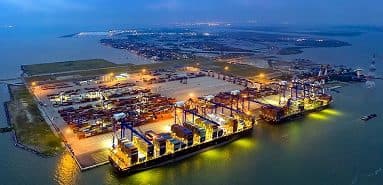
Resolution 45 of the Politburo on developing Hai Phong city to 2030, vision to 2045 identifies that developing logistics services is one of the goals, and also a solution for Hai Phong to rise in the process of industrialization and modernization, becoming an industrial city associated with a modern seaport. To achieve this goal, the city approved the logistics development plan, building Hai Phong with a synchronous and modern logistics center system as a development foundation.

Build a city-level logistics center in Lach Huyen, associated with Hai Phong international gateway port.
Photo: GIANG SON DONG
Part 1: Exploiting potential, developing diversity
Resolution 45 of the Politburo on developing Hai Phong city to 2030, with a vision to 2045, identifies that developing logistics services is one of the goals, and also a solution for Hai Phong to rise in the process of industrialization and modernization, becoming an industrial city associated with a modern seaport. To achieve this goal, the city approved the logistics development plan, building Hai Phong with a synchronous and modern logistics center system as a development foundation.
Untapped and well-developed logistics potential
According to the Ministry of Transport, Hai Phong is the transportation hub of the North with all 5 types of transportation including sea, road, air, railway and inland waterway. In Hai Phong, there are many leading port, transportation, import-export businesses with potential for logistics development in the country. Domestic and foreign enterprises coming to Hai Phong to invest in logistics development are continuously increasing. Up to now, Hai Phong area has more than 500 enterprises operating logistics, including many large logistics centers such as: logistics centers of Saigon Newport Corporation, GSL, DH, Yusen, Hai An...
However, according to experts, logistics development in Hai Phong is still limited because businesses operating logistics services in Hai Phong are fragmented, inexperienced, and only provide basic services. Most small and medium-sized enterprises have very limited financial capacity and ability to provide logistics services, mainly transporting goods. Many businesses provide services on the existing system (1PL level) and only participate in part of the logistics chain such as: check-in procedures, loading and unloading, warehousing, transportation..., working for large logistics businesses. Therefore, it is necessary to plan the logistics development of Hai Phong city to maximize the potential, advantages, and adjust the general development direction.
On March 14, 2019, the City People's Committee decided to approve the planning for developing Hai Phong city's logistics service system until 2025, with a vision to 2030 to develop a synchronous, modern network of logistics centers, meeting the needs of production and circulation of domestic goods as well as import and export goods in the region and internationally.

Developing warehouses to store goods is one of 17 types of logistics that the city encourages and creates conditions for businesses to invest. In the photo:Tan Vu branch warehouse of Hai Phong Port Joint Stock Company.
Photo: DUY THINH
Building 17 types of services in the logistics chain
According to the plan, by 2025, with a vision to 2030, Hai Phong city will develop a variety of services in the logistics chain to increase the value of logistics services for each ton (container) of goods passing through the ports. From now to 2030, Hai Phong will build 17 types of services in the logistics chain, including: loading and unloading, warehousing to support maritime transport, warehousing to support all modes of transport, delivery, transport agents, customs clearance agents, other services, wholesale support, marine transport services, inland waterway transport services, railways, aviation, multimodal transport, inspection, transport support services...
Deputy Director of the Department of Transport Hoang Trieu Hung said that in the immediate future, the city focuses on developing main logistics services, directly serving the seaport and airport system, including: freight transportation, customs clearance agents, maritime freight transportation, and multimodal transportation. These types of services account for about 57% of total logistics costs. Next, support for other services such as: container warehousing (accounting for about 20% of the cost), container loading and unloading (accounting for 11% of the cost) and other services (accounting for 12% of the total logistics cost)...
On the foundation of development, the next step is for Hai Phong city to transform the type of self-sufficient logistics service (1PL) to focus on perfecting the 2PL service type (providing services to a second party) and prioritizing the development of 3PL services (providing services to a third party or under contract) by 2020. After 2020, focus on converting the type of service 2PL, 3PL and prioritize higher level development such as 4PL (main logistics provider) and 5PL (service provider to 5th parties).... Boldly bringing 4PL and 5PL levels into the planning shows a very new point and determination of Hai Phong city towards professional logistics services. The success of logistics is to provide as many service chains to partners as possible in the end, that is growth.
Expand transport corridors
To develop the logistics field in Hai Phong to match its potential and advantages, affirming its position in the country, planning and expanding transport corridors and supporting the circulation of goods play an important role. According to the leaders of the Department of Transport, the city is planning 3 freight corridors to/from the city, including: the Hai Phong-Hanoi route connecting with the Lao Cai branch to Yunnan (China) and connecting with the Lang Son branch to Guangxi (China). The second route is Hai Phong-Ha Long-Mong Cai and the third route is Hai Phong-Thai Binh-Nam Dinh-Ninh Binh.
Among these, the Hai Phong-Lao Cai, Lang Son to China route is arranged with 3 modes of transport including: road, railway and inland waterway. The road route follows National Highway 5 (or Hanoi-Hai Phong expressway)-Quang Ninh, Hai Phong urban trunk road, Kinh Mon-Thuy Nguyen inter-provincial route.
The Hai Phong-Mong Cai route is transported by road and inland waterway, including the road from Dinh Vu to Highway 10 - coastal road. The Hai Phong-Ninh Binh route also follows roads and inland waterways, and after 2030, a railway will be built... In addition, some routes will connect to Cat Bi International Airport.
In order for the road corridor to develop, the city is speeding up the construction progress of projects such as: Hai Phong urban traffic development project, South Binh Cau intersection construction project, Hoa River bridge construction project... and preparing to build Quang Thanh bridge, Dinh bridge, Ben Rung bridge... The process of quickly and smoothly transporting goods is one of the components to improve the quality of logistics services and restructure freight transport services. transformation towards cost reduction, increased competitiveness, international integration.../.
Last period: Dedicate strong resources to investment
Resolution 45 of the Politburo clearly states: By 2030, Hai Phong will become a modern international logistics center with all types of transportation. To achieve this goal, the resolution also sets out tasks and solutions, including planning and building large logistics zones associated with seaports, with synchronous, modern, and smart infrastructure. According to Hai Phong's logistics development plan until 2025, with a vision to 2030, the city will invest in 6 large centers, playing a focal role, gradually perfecting the chain of logistics activities to reach the national, regional and world level.
Forming large, modern centers
According to the leaders of CBRE (Vietnam) Co., Ltd., Hai Phong has the foundation and potential to become a main logistics center of Vietnam and in the future a transit point of regional and global logistics networks. Hai Phong's transportation infrastructure is gradually synchronous, but there is still a lack of large logistics centers that play a coordinating role at the city and national levels. Therefore, to develop logistics in the future, the city needs to build large logistics centers that can create breakthroughs to support this industry's development. These centers will help Hai Phong logistics grow strongly and become the country's leading locality in this service, while also reaching an international level; not only plays a connecting role,but also the "referee" who coordinates this activity.
Currently, Hai Phong has about 20 logistics centers, but most are small, only serving one or a few businesses; only participate in a few activities in the logistics chain. Therefore, in the first phase of planning implementation, from now to 2020, Hai Phong aims to form 4 logistics centers with a total volume of goods passing through the centers reaching about 71.6 million tons/year (of which 4.01 million container containers/year), taking on 40-50% of the total amount of goods in need of logistics services in the city. This is an outstanding step forward for Hai Phong city in national logistics growth, because currently the amount of goods coordinated by logistics centers is still too small.
4 large logistics centers are planned including: 1 regional center, Nam Dinh Vu logistics center in Nam Dinh Vu Industrial Park (East); 3 city-level centers in Lach Huyen (Southeast), VSIP area in VSIP Industrial Park (Northeast) and Trang Due area in Trang Due Industrial Park (West). These 4 centers will play the role of receiving and handling transportation and circulation of goods by road, seaport and air.
By 2025, Hai Phong plans to add 2 centers in Tien Lang district and Cat Bi airport, bringing the total number to 6 logistics centers. Hai Phong will continue to upgrade 6 centers to modern ones, to support the total throughput of goods up to 140.35 million tons/year, taking on 60-65% of the total amount of goods needed to provide logistics services in the city.
Ensuring site and capital for development
Newly invested and built logistics centers will be the driving force to attract and coordinate goods from Hai Phong ports; attracting an increasing amount of goods through the port, meeting the need for goods transshipment services for the country and the world. Forming large logistics centers also helps reduce service costs, encourages active logistics service delivery areas to continue operating effectively, improving competitiveness and professionalism. Therefore, the city proactively develops land use plans to meet the development needs of this field.
Specifically, by 2020, the city strives to reserve about 1,891.5 hectares of land for construction according to logistics development planning. By 2025, this area will be 2,061 hectares and by 2030 2,165 hectares. According to experts, with a large land area for logistics development and the construction of 6 large centers, Hai Phong will become the country's leading locality in prioritizing logistics service development. Promoting Hai Phong's advantage that coastal lands are in the process of "portization", the formation of large logistics centers, applying modern technology will turn the city into a locality with bustling import-export activities, attracting investment and especially, the source of money and goods pouring into the city is increasingly large.. Experts also say that, with 44 seaports, of which only 2 deep-water ports have been put into operation, in 2018 Hai Phong reached 110 million tons of goods passing through the port. In 2020, when the port continues to expand towards the sea, combined with 4 large logistics centers, the amount of goods passing through the port will far exceed the above figure.
An additional advantage is that hundreds of trillions of VND will be invested in Hai Phong when further implementing port projects in Lach Huyen... In particular, the city's capital for logistics development continues to grow in stages. According to the plan, tens of thousands of billions of VND will be invested to develop Hai Phong logistics. Specifically, the period 2018-2020 is up to 3,555 billion VND, (of which state budget capital supports 15%); In the period 2021-2025, capital needs reach more than 9,000 billion VND (state support 18%); In the period 2026-2030, the capital need is 4,500 billion VND (20% state support). Funds supported by the state mainly serve site clearance, call for investment and support training and human resource development. Storkn again mobilize all resources of society including foreign investors.
To reach an international level in the 4.0 industrial era, Hai Phong logistics development will entail perfecting the application of new technology in logistics, contributing to promoting trade facilitation and restructuring production and trade activities of enterprises. On the other hand, it also promotes the application of information technology to develop the Hai Phong city database system, build E-logistics connected to the "national single window" and "ASEAN single window" systems...
The goal of Hai Phong logistics planning is to achieve a growth rate of 25-30%/year by 2020, 30-35%/year growth by 2025, and 30-35%/year growth by 2030. In the period 2020-2030, new logistics centers will handle from 40% to 70% of the goods needed to provide logistics services. The rate of outsourced logistics (suppliers performing logistics on behalf of businesses) reaches 40-65%./.
Mai Lam
baohaiphong.com.vn