
 Procedures

Online mailbox
Receiving feedback and proposals from organizations and individuals.

(Haiphong.gov.vn) - On the morning of September 26, the Government organized a national online conference on promoting the allocation and disbursement of public investment capital in 2019 under the […]
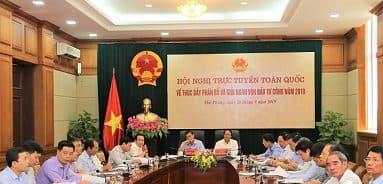
(Haiphong.gov.vn) – On the morning of September 26, the Government organized a national online conference on promoting the allocation and disbursement of public investment capital in 2019 under the chairmanship of Prime Minister Nguyen Xuan Phuc. Attending the Conference were Deputy Prime Minister Vuong Dinh Hue, Deputy Prime Minister Trinh Dinh Dung, Vice President Dang Thi Ngoc Thinh, leaders of ministries, branches and 63 provinces and cities at online television stations.
At the Hai Phong bridge, the City Party Secretary and Chairman of the City People's Council Le Van Thanh; Chairman of the City People's Committee Nguyen Van Tung; Vice Chairman of the City People's Council Bui Duc Quang; Vice Chairman of the City People's Committee Nguyen Van Thanh and leaders of relevant departments, branches and units.

Hai Phong city bridge point at this morning's online session
According to the Ministry of Planning and Investment, public investment capital disbursement in the first 9 months of 2019 is estimated to reach 192,136 billion VND, equal to 45.17% of the plan assigned by the National Assembly and 49.14% compared to the plan assigned by the Prime Minister, lower than the same period in 2018, of which, disbursement of Government bond capital and ODA capital are both low.
There are 7 ministries, branches and 14 localities with disbursement rates of more than 70%, of which 4 ministries, branches and 4 localities have disbursement rates of more than 80%. There are 31 ministries, central agencies and 19 localities with disbursement rates below 50%, of which, 17 ministries, central agencies and 1 locality have disbursement rates below 30%.
In general, the disbursement situation of the public investment capital plan in the first 9 months of 2019 is basically similar to previous years, the disbursement rate in the first months of the year is low, with a strong upward trend in the last months of the year. In addition to the reluctance to disburse multiple times and to carry out capital settlement procedures multiple times by both investors, project management boards and contractors, mainly done at the end of the year, the trend of disbursement gradually increasing at the end of the year is also due to the basic reason of the specific nature of investment expenditure compared to regular expenditure.
According to the summary of the Ministry of Planning and Investment, some causes of slow disbursement include a number of institutional and legal problems in public investment. Some regulations after a period of implementation revealed many limitations such as investment decisions must be made before October 31 of the previous year, saving 10% of the total investment, allowing capital disbursement for 2 years, abolishing regulations on authorized Standing People's Councils... need to be removed.
The implementation of the provisions of the Land Law, Construction Law, Bidding Law, Law on Environmental Resources Protection... is still confusing, takes a lot of time in site clearance, and there are some problems with land complaints; Procedures for design approval, project estimates, and contractor selection are lengthy...
Planning work is not close to reality and the ability to allocate capital and disbursement of capital leads to not being able to fully allocate the planned capital. Plan delivery is slow and not in accordance with project progress requirements. All levels and sectors have not really participated, the roles and responsibilities of the leaders have not been highlighted and are not clear.
The causes of slow disbursement of ODA capital have many specific characteristics. Many projects have to make adjustments to loan agreements even though the project has completed volume but cannot disburse; Investment and project preparation work still has shortcomings, leading to low project readiness; Some projects did not receive adequate and timely counterpart capital, affecting the ability to absorb and disburse foreign capital.
Based on the opinions of the Government leaders, ministries, branches and localities at the Conference, the Ministry of Planning and Investment proposed that the Prime Minister consider and assign the Ministry to preside over and coordinate with relevant agencies to draft a Government Resolution on main tasks and solutions to speed up the disbursement of public investment plans, reporting to the Government at the regular Government meeting in September 2019.
Speaking at the conference, Prime Minister Nguyen Xuan Phuc clearly stated that public investment greatly contributes to the country's growth and socio-economic development, especially important infrastructure projects. Public investment accounts for 10.7% of total GDP value, about 32% of total social investment in 2019. The slow disbursement of public investment over the past ten years has created a "bottleneck" for the economy, especially this year's low disbursement.

Prime Minister Nguyen Xuan Phuc gave a directive speech. Photo: VGP/Quang Hieu.
The Prime Minister analyzed and pointed out 4 major consequences from the slow disbursement of public investment capital. Firstly, the impact on economic growth due to the capital factor is one of the important factors of GDP growth. Second, public investment capital is often one of the resources of large projects and important infrastructure, so when it is delayed, it will also hold back other private and foreign counterpart capital flows, affecting social capital mobilization, affecting national reputation, reducing the confidence of investors and donors. Third, it causes great waste when the money lies there and the Government has to pay additional capital costs. Fourth, businesses and investors have to bear increased costs, reduced employment, increased debt and reduced business reputation.
At the conference, the Prime Minister proposed to clarify the basic objective and subjective causes of slow disbursement. "Comrades said that the premises, procedures, construction capacity, especially the institutions... but there are many localities and sectors with the same situation but disbursement is very good, up to 70-80%. But there are many sectors and localities where disbursement is only 10-15%. The Prime Minister directed ministries, sectors and localities to come up with practical, specific, accurate and stronger solutions for better disbursement with 3 months left until the end of the year. 2019, as well as learn from this year's experience to make disbursement more timely and stricter next year.