
 Procedures

Online mailbox
Receiving feedback and proposals from organizations and individuals.

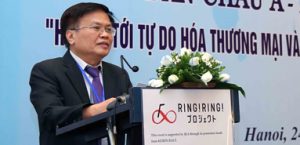 November 24, 2016, in Hanoi, Central Institute for Economic Management (CIEM), Ministry of Planning and Investment in coordination with the Japan Economic Foundation (JEF) to organize cAsia-Pacific Forum 2016 (APF): Towards trade and investment liberalization in the Asia-Pacific region.
Opening speech at the Forum, Dr. Nguyen Dinh Cung, Director of CIEM, emphasized that domestic economic reform and international economic integration are two indispensable parallel processes, contributing to promoting economic development and improving people's welfare. Vietnam began its integration by joining ASEAN in 1995, participating in free trade agreements between ASEAN and its partners, signing a trade agreement with the United States in 2001, joining the WTO in 2007... Currently, Vietnam has signed, participated in and negotiated dozens of trade agreements with leading countries and partners in the region and the world.
Reality shows that, in addition to the global economic difficulties from 2008 until now, joining the WTO has not been accompanied by domestic economic reforms, leading to a clear separation between the domestic economic sector and the foreign-invested economic sector, between urban and rural areas. The opportunities that WTO brings are mainly taken advantage of by foreign investors in Vietnam, the domestic economic sector is still developing slowly.
Faced with that situation, on November 1, 2016, the Central Executive Committee of the Communist Party of Vietnam issued Resolution 05-NQ/TW on a number of major guidelines and policies to continue innovating the growth model, improving growth quality, labor productivity, competitiveness of the economy and Resolution No. 06-NQ/TW dated November 5, 2016 on implementation. effectively process international economic integration, maintain political and social stability in the context of our country participating in new generation free trade agreements. On November 8, 2016, the National Assembly passed the Resolution on the Economic Restructuring Plan for the period 2016-2020. These are efforts, political commitments, consensus to promote reform, strong domestic market orientation, andSolve the basic problems of the economy and continue to consistently deepen economic integration to restore the driving force of comprehensive growth.
Economic integration is an inevitable activity and the APF Forum 2016 is a good opportunity to help Vietnam identify new trends, phenomena, and ways to effectively integrate into the international economy in general and in the Asia-Pacific region in particular, and at the same time propose solutions for integration and promote domestic economic reform.
Mr. Kazumasa Kusaka, President and CEO of JEF, said that APF 2016 is the 15th forum, which includes many discussions inside and outside borders on the business investment environment, enhancing growth potential domestically as well as in the region. Free trade agreements, the formation of the ASEAN Economic Community, the EU Community or the TPP Agreement... confirm that the most difficult task is not the negotiation with partner countries but the support and efforts from the domestic community. The challenge for each country participating in integration is to improve socio-political stability by improving people's understanding and awareness of the benefits of trade liberalization.and investment, contributing to supporting economic reforms and restructuring, narrowing the gap between rich and poor in society. Cooperation to put trade agreements into practice and development is essential for the regional economic growth strategy to achieve success. Therefore, Mr. Kazumasa Kusaka believes that APF 2016 will further strengthen regional cohesion and contribute to sustainable economic development and regional economic integration.
At the Forum, delegates heard presentations on regional economic integration, including the liberalization of trade, investment and services, connecting to access new opportunities and reducing transaction costs, and cooperation to improve institutional and human resources capacity to effectively exploit opportunities and improve recovery efficiency, aiming for prosperity, inclusive and sustainable growth and narrowing the development gap. It identifies key trends in the next 20 years (according to the Vietnam 2035 Report) including: A multipolar world, geopolitical pressures and the middle class; Population aging, urbanization; Artificial intelligence, 3D printing technology, new energy, biotechnology; Super FTAs (TPP, TIIP, RCEP, FTAAP),institutional reform at regional and global levels; Resource competition and climate change; Emerging Asia (China, India); The dominance of the USD is gradually declining. Thereby setting out the ASEAN integration vision to 2025 including 5 pillars: A highly integrated and cohesive economy; A competitive, creative and dynamic ASEAN; Strengthen industry connections and cooperation; An ASEAN that is resilient, inclusive, people-oriented and people-centred; A global ASEAN.
The forum had 3 sessions that attracted participation in discussion and comments from delegates with the following contents: Roadmap for economic integration in the Asia-Pacific region - Issues of concern; New issues in regional trade and investment liberalization; Linking trade with domestic reform – Creating a solid consensus towards economic growth./.