
 Procedures

Online mailbox
Receiving feedback and proposals from organizations and individuals.

(Haiphong.gov.vn) - On the morning of May 14, at the City Convention Center, the City People's Committee held a conference to summarize 15 years of implementing Resolution No. 13/NQ/TW dated March 18, 2002 [...]
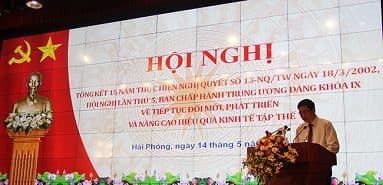
(Haiphong.gov.vn) - On the morning of May 14, at the City Convention Center, the City People's Committee held a conference to summarize 15 years of implementing Resolution No. 13/NQ/TW dated March 18, 2002, the 5th Conference of the IX Party Central Committee on continuing innovation, development, and improving collective economic efficiency. can. Attending the Conference on the Central side were comrades: Cao Duc Phat, Member of the Party Central Committee, Standing Deputy Head of the Central Economic Committee, Member of the Steering Committee summarizing Resolution No. 13; Nguyen Hieu, Deputy Minister of Planning and Investment. On the city side, there were comrades: Nguyen Thi Nghia, Permanent Deputy Secretary of the City Party Committee, Head of the National Assembly Delegation of Hai Phong city; Nguyen Van Thanh,Member of the City Party Committee, Vice Chairman of the City People's Committee; leader of the city's Vietnam Fatherland Front Committee; leaders of departments, branches, branches, localities, related units and more than 150 Cooperatives (Cooperatives) in the city.

Conference Scene
According to the report, in the past 15 years, the collective economy has made certain contributions to the city's socio-economic development, contributing to exploiting potentials, advantages, creating jobs, ensuring social security and political stability at the grassroots, especially in rural areas. Many cooperatives were formed, consolidated, and innovated; A number of advanced, effective production and business models have appeared. Links between cooperatives and other economic units and organizations have been strengthened and initially promoted effectively. In particular, in the agricultural and rural areas, collective economic units have become active factors in industrialization, modernization of agriculture and building new rural areas, developing more products and services.New mound, better support for member household economy, farm economy, improving the material and spiritual life of the people and strengthening community cohesion. These important results are the premise for continuing to consolidate, innovate and develop the collective economy in the next period.
Developing the collective economy with cooperatives at its core is a major and consistent policy of the Party. Collective economic development is to contribute to building a society of cooperation, solidarity, shared prosperity and democratic management, contributing to promoting the cause of industrialization and modernization of the city, especially for agriculture and rural areas. Strive by 2030, the collective economic sector and cooperatives will have an important role and position in the economic, cultural and social development of Hai Phong city. By 2025, the collective economy will contribute from 1 - 1.5 GRDP to the city; The income of members and workers in cooperatives is stable, increasing by 15%/year. 100% of cooperatives have access to market, science and technology information.
To continue to innovate, develop and improve collective economic efficiency, the City People's Committee proposed 8 main groups of solutions, with the following key solutions focusing on: Improving the quality and effectiveness of propaganda on collective economy and cooperatives. Focus on human resources, training and fostering human resources for the collective economic sector. Continue to consolidate the operations of cooperatives in accordance with the true nature of cooperatives, the 2012 Law on Cooperatives and guiding documents. Building and replicating new cooperative models. Support and encourage improvement of production and business activities. Strengthen domestic and foreign cooperation.
Speaking at the Conference, comrade Cao Duc Phat, Member of the Party Central Committee, Standing Deputy Head of the Central Economic Commission emphasized: collective economic development is an important part of the national economy, a consistent policy of the Party expressed in the platform and many documents. Resolution No. 13 of the Central Executive Committee clearly stated the goals and 5 important groups of solutions to develop the collective economy with the core being cooperatives. Reality in our country shows that collective economic development is an urgent objective need to develop many economic fields, especially to restructure agriculture associated with building new rural areas. The city's summary report has been preparedmeticulously constructed, closely following the outline of the Central Steering Committee; Specify the achieved results, frankly point out the problems and causes of problems and weaknesses, propose viewpoints, goals, and solutions to promote collective economic development in the period up to 2030, and make recommendations to central agencies.
The Central Economic Committee basically agrees with the city's comments and proposals and agrees with the highly practical opinions expressed at the Conference. Through surveys and listening to reports and presentations at the Conference, the Central Economic Committee drew many important things to report to the Central Steering Committee to synthesize into the overall project submitted to the Central Government. Over the past 15 years, Hai Phong city has seriously implemented Resolution No. 13; Through organization and thorough implementation, the City Party Committee has a guiding Resolution, the People's Committee has an Action Plan to implement the Resolution, issued many Plans, Directives, and policies and has regularly paid attention to directing the implementation of the Resolution.
Practices of Hai Phong city show that despite many difficulties, the collective economy has been contributing an important role in stabilizing and supporting economic development in many areas and many socio-economic fields of the city, especially agriculture and new rural construction. Although there have been many advances, in general the collective economic development is still slow, contributing little to the city's overall economy. Most small-scale cooperatives still face many difficulties, some cooperatives are slow to innovate, have low operational content and efficiency, and even exist in form, while a large number of cooperatives have stopped operating but have not been converted.
Comrade Cao Duc Phat, Member of the Party Central Committee, Standing Deputy Head of the Central Economic Commission agreed with the objective and subjective reasons stated in the city's report, especially the comments about the inadequacy and lack of feasibility of some policies such as policies on land, social insurance, credit, and the quality of human resources in cooperatives and the state management apparatus. for collective economy... He suggested that it is necessary to analyze more deeply the awareness and approach to collective economy and cooperatives from the institutional environment and social psychology in general for the development of collective economy and cooperatives.
Comrade Cao Duc Phat strongly agreed with the policy of Hai Phong city in the coming time to continue to innovate and develop faster the collective economy, the core of which is cooperatives to promote Hai Phong's advantages, making a worthy contribution to the city's socio-economic development; 8 main groups of solutions proposed by Hai Phong city. However, at the macro level, it is necessary to research, innovate awareness, approach and especially need to adjust policies that are consistent with the market mechanism and are highly feasible to have a stronger change in the development of the collective economy in the coming period. On the other hand, it is necessary to strengthen the capacity of the state management apparatus for the collective economy, promoting the role of the Cooperative Alliance and unions under the direction of all levels.committee. The Central Economic Committee will receive the city's recommendations to the Central Committee, synthesize them and send them to the Steering Committee to report to the Politburo and the Central Executive Committee.
Speaking at the Conference, comrade Nguyen Thi Nghia, Permanent Deputy Secretary of the City Party Committee, Head of the Hai Phong City National Assembly Delegation, on behalf of the City Party Committee, thanked the notes and assessments of comrade Cao Duc Phat, Member of the Party Central Committee, Standing Deputy Head of the Central Economic Commission on the results of implementing Resolution No. 13 of the Central Executive Committee (term IX) in over the past 15 years and fully absorbed your instructions. Along with the implementation of 8 main groups of solutions, comrade Nguyen Thi Nghia requested departments, branches and unions to continue to strengthen the dissemination and thorough understanding of the Resolutions and conclusions of the Central Committee and the Standing Committee of the City Party Committee on continued innovation and development.Developing and improving the collective economy in association with the 2012 Law on Cooperatives. Party committees and authorities at all levels direct the implementation of the Resolution more strongly, concretizing and implementing the contents of leadership and direction for collective economic development, considering this a key and regular task in socio-economic development programs and plans. Strengthen the work of building and consolidating the development of Party organizations and unions in collective economic units. Sectors and localities immediately carry out the review and re-evaluation of collective economic units within the sectors and localities, with a focus on cooperatives. Select a number of good units to focus on supporting the development of a model model for replication, research, and absorption of domestic and international experience to perfect the model. Done fullAdequate and timely policies to support and encourage collective economic development of the Central Government. Review, evaluate and consolidate the organizational apparatus and state management officials of the collective economy in a professional and specialized direction. Strengthen administrative reform, especially procedures for registering to establish collective economic units, and for benefiting from mechanisms and policies.
Comrade Nguyen Thi Nghia requested the City Cooperative and Enterprise Alliance to constantly improve its role, responsibility and operational efficiency, ensuring good promotion of the representative role of collective economic units. The City Fatherland Front, people's organizations at all levels, organizations and associations need to have plans and action programs to coordinate with relevant organizations to well carry out the work of gathering, advocating, propagandizing and educating the masses, members and members to voluntarily participate in collective economic development in accordance with the spirit of the Resolution and the provisions of the law.
Nguyen Hai