
 Procedures

Online mailbox
Receiving feedback and proposals from organizations and individuals.

Many large corporations continue to pour capital into Vietnam. Many large corporations are continuing to plan to invest in Vietnam, pushing investment capital […]
Many large corporations are continuing to plan to invest in Vietnam, pushing the flow of foreign direct investment (FDI) into Vietnam to increase over the same period.
Detailed information has not been disclosed, but it is likely that LG Innotek, a subsidiary of LG Group, will invest in a project specializing in camera production in Dinh Vu - Cat Hai Economic Zone (Hai Phong). The project is expected to have an investment capital of 200 million USD, and will likely be granted an investment certificate soon.
Actually, if counted individually, this is not a very large FDI project and still has less investment capital than the project in which Seoul Semiconductor Company (Korea) was recently awarded an investment registration certificate by Ha Nam province. Seoul Semiconductor, according to the plan, will invest up to 300 million USD to build a factory specializing in manufacturing semiconductor products and LED lights in the expanded Dong Van I Industrial Park.
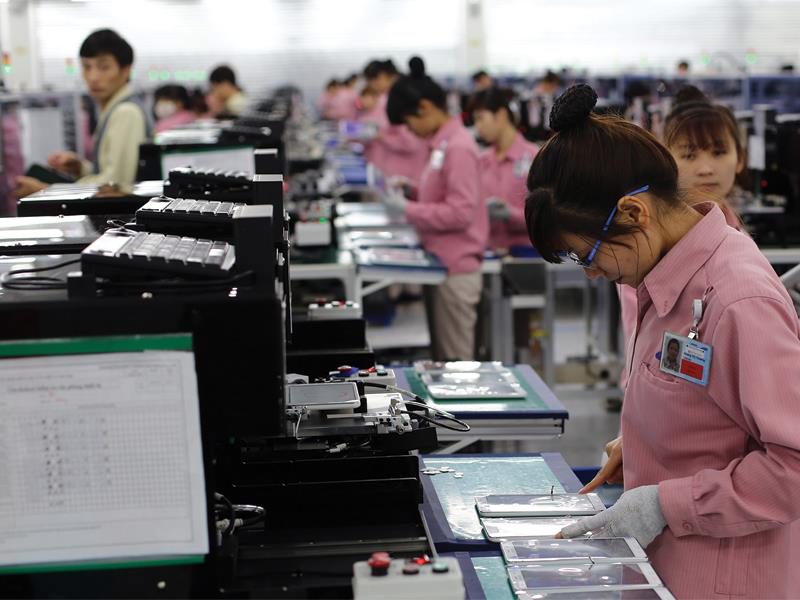 After Samsung, more and more Korean businesses have been finding their way to Vietnam to open new production facilities. Photo: Duc Thanh
However, this is the third investment project of LG Group in Vietnam, after the 1 billion USD home electronics manufacturing complex project and the LG Display Project, with an investment capital of 1.5 billion USD, which was just granted an investment certificate last month. All 3 of these projects are being implemented in Hai Phong and the fact that LG invested in 3 projects here at the same time proves one thing, LG is really moving production to Vietnam like their previous statement.
Thus, after Samsung, it is the turn of another Korean giant to establish a global production base in Vietnam, with its key products. Not only large corporations, but more and more small and medium-sized Korean enterprises have also been finding their way to Vietnam to open new production facilities.
And not only Korea, Japanese businesses are also pouring capital into Vietnam. According to recent information in Nikkei Daily, Japan's largest air conditioner manufacturer, Daikin Industries, is planning to build a new production facility in Vietnam. The value of this investment is estimated at 93.6 million USD. The factory is expected to start construction in 2018, expected to produce half a million air conditioners per year. If the economic situation is favorable, by 2020, Daikin – a very familiar brand in the Vietnamese market – will double its production capacity.
Very positive information shows that FDI capital will continue to flow into Vietnam, although global investment capital - according to UNCTAD - has not improved much. Announcing the macroeconomic report for the second quarter of 2016 yesterday (July 26), Mr. Nguyen Dinh Cung, Director of the Central Institute for Economic Management (CIEM), considered FDI attraction a bright spot of the economy in the first half of 2016.
The situation is even more positive, as the latest data from the Foreign Investment Agency shows that in the first 7 months of the year, an estimated 12.94 billion USD of FDI capital poured into Vietnam, a sharp increase over the same period. Of which, the new registered capital is nearly 8.7 billion USD, while the additional capital is 4.25 billion USD. With disbursed FDI capital, the number is also very positive: 8.55 billion USD, an increase of 15.5% over the same period last year.
Not only appreciating the contributions of the FDI sector in the first 7 months of the year, with the export turnover of this sector reaching over 68.9 billion USD, CIEM's report also emphasized that the FDI sector has contributed a significant and increasingly important part in the entire Vietnamese economy, stimulating the competitiveness of businesses in the same industry, creating jobs for workers, improving the level of technology and management in the country through "impact". overflow". In addition, FDI enterprises also attract many satellite investors to help develop industry, increase opportunities to participate in the global value chain and access international markets for Vietnamese enterprises.
However, frankly, CIEM experts have also pointed out that in recent years, the spillover impact of the FDI sector has not been much. Domestic enterprises have hardly participated in the chain linking with FDI enterprises. Therefore, although there are many FDI "giants" pouring into Vietnam, to optimize the benefits of this capital flow, as well as to promote economic growth, we must increase the participation of Vietnamese enterprises in the regional supply chain.
"Here there is a problem related to supply and demand not meeting each other. Domestic enterprises want to have off-take contracts with FDI enterprises to feel secure in investing in production technology, while FDI enterprises already have their own supply networks and often expect domestic enterprises to proactively offer and prove their supply capacity. Meanwhile, the intermediary role of regulatory agencies - to introduce and connect domestic suppliers with FDI enterprises - is still faint," Mr. Cung said. Propose the strengthening of the intermediary role of state agencies to promote links between domestic enterprises and FDI enterprises.
Along with that, before the Formosa incident, CIEM also recommended the implementation of solutions to minimize the environmental impact of the FDI sector.