
 Procedures

Online mailbox
Receiving feedback and proposals from organizations and individuals.

Welcoming the wave of investment in industrial park real estate Vietnam's signing of many new generation free trade agreements (FTAs) has attracted […]
Vietnam's signing of many new generation free trade agreements (FTAs) has attracted investors into industrial park real estate. However, it is not easy to succeed when investing in this segment if investors do not have long-term plans and support from policies.
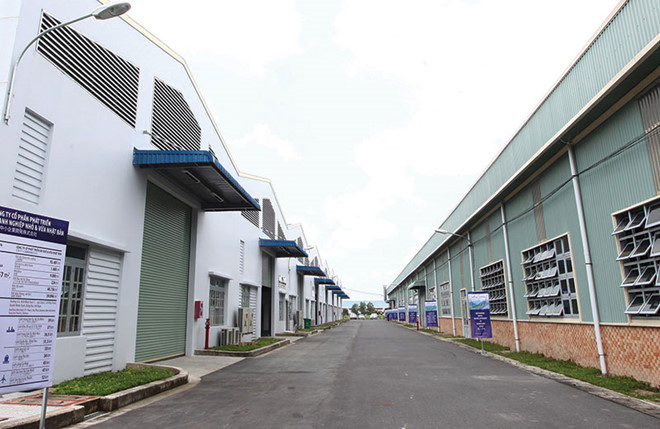 Industrial parks that have been put into operation have an occupancy rate of nearly 70%. Photo: Le Toan
Seize opportunities
According to a report from the Department of Economic Zones Management (Ministry of Planning and Investment), by the end of June 2016, the whole country had 16 economic zones established with a total land and water surface area of 814,792 hectares and 313 industrial parks with a total natural land area of more than 88,000 hectares. Of which, the area of industrial park land that can be rented reaches 60,000 hectares, accounting for about 68% of the total natural land area.
To date, there have been 218 industrial parks in operation, with a total natural land area of nearly 60,000 hectares and 95 industrial parks are in the stage of site clearance compensation and basic construction, with a total natural land area of more than 28,000 hectares. The total area of industrial land leased reaches over 28,500 hectares, with an occupancy rate of 49%. Particularly for industrial parks that have been put into operation, the occupancy rate has reached nearly 70%.
According to estimates, the number of industrial parks in Vietnam will increase rapidly in the near future, because a series of domestic and foreign investors are preparing to jump into this segment to catch the wave of foreign investment when the Trans-Pacific Partnership Agreement (TPP), Vietnam - EU FTA (EVFTA) and most recently the ASEAN Economic Community (AEC) are implemented.
A study by Standard Chartered Bank showed that about 44% of units participating in the study chose Vietnam as an investment destination due to its large domestic market, 29% cited low operating costs and 18% cited abundant labor.
Talking with Real Estate Investment, lawyer Nguyen Thanh Ha, Chairman of SBLaw Law Firm, said that the boom in industrial park projects is due to the fact that Vietnam's economy is regaining growth momentum, while many multinational corporations are shifting investment out of China and Vietnam is one of the attractive destinations for this capital flow, typically Microsolf, Samsung or Intel...
When participating in TPP, many foreign investors will come to Vietnam to open businesses, because they want to take advantage of the cheap, abundant labor source and especially take advantage of origin incentives according to TPP regulations to access a large market of more than 800 million people, accounting for 40% of GDP and nearly 30% of global trade.
Need more support policies
In reality, not every industrial park receives a lot of attention from manufacturers. Real Estate Investment's survey shows that the top choice for building factories of investors, especially foreign investors, is industrial parks that have been invested synchronously in terms of infrastructure, electricity and water.
Sharing with Real Estate Investment, Mr. Nguyen Van Dung, Chairman of the Board of Directors of Bao Thu Industrial Development and Investment Joint Stock Company, a unit that is implementing a number of industrial park projects in Binh Thuan and Quang Tri, said that developing industrial park real estate projects comes from the actual demand of the rapidly growing market, but it is not necessary to ask for land and build a surrounding fence to be able to offer leases to foreign partners. Foreign investors are quite picky, they are very interested in the infrastructure planning of an industrial park project, from walkway infrastructure, to electricity lines, water lines, waste treatment areas..., not simply the cost of premises, how cheap the labor cost is.
In addition to the State's general incentives for each industrial park, foreign investors are also interested in whether the network of raw material and auxiliary material suppliers is ready for factory operations in the industrial park. At the same time, they are also concerned about whether the investment licensing procedures in industrial parks are clear and whether the licensing time can meet the project implementation schedule.
“If the investor of an industrial park project does not have good planning, does not have synchronous connection, and does not carry out all legal procedures, then benefiting from other incentives will not make any sense,” Mr. Dung said.
However, in addition to the efforts of investors, Mr. Dung also recommended that incentive mechanisms specifically for industrial park development need to be clearer and more encouraging, to help businesses overcome difficulties and avoid situations where due to entanglements in the mechanism, they have to invest in a fragmented and small way, which does not bring many benefits to localities.